Photographer based in South Africa & the Netherlands

Farren van Wyk
Tell us about yourself, what's your background?
I was born in South Africa in 1993 and moved to the Netherlands with my South African mother and Dutch dad. Here, my three brothers were born. From a very young age, I wanted to go to art school, and when I was accepted to the University of the Arts in Utrecht (HKU) at the age of 18, a dream came true. As long as I can remember, I was always drawing, but I got frustrated with myself because it never felt good enough. When I got my first camera, I realised that I could create what I wanted through photography instead of paper and pen.
Art school also showed me what it means to do artistic research and how it feeds projects with layers of information and symbolism. I wanted to continue on the path of research and chose a Master's Degree in Social and Visual Anthropology. This has helped me deepen my practice as an artistic researcher and research lecturer. I am teaching at the University of the Arts in Utrecht (HKU), an alumna lecturer back where it all started.
Identity and sense of belonging became red threads throughout my work. As a photographer and woman of colour, what does it mean to live in a world that racially classified me? Photography became my medium to figure out where I belong and reconnect with my African roots.

The Black Panthers meet Nelson Mandela. 2024
“Mother nature and the female body both bloom, wilt and regenerate through the process of Metamorphosis as a rebirth. I was born in South Africa and raised in the Netherlands, making this project an understanding of the relationship between my two homes.”

Marck-Anthony & Benjamin. 2025
What are you currently working on and where did the inspiration for it come from?
I am currently doing research for a new project. Centring around (self-)portraits and still lives, exploring and experimenting with parallels between the female body, as a woman of colour, and South African indigenous flora and fauna. The concept originates from the idea of “giving her flowers”; expressing gratitude and appreciation to my lineage of ‘mothers’ and mother nature. In various African cultures, the life-giving matriarch is culturally celebrated. Mother nature and the female body both bloom, wilt and regenerate through the process of Metamorphosis as a rebirth. I was born in South Africa and raised in the Netherlands, making this project an understanding of the relationship between my two homes.

Craniometry Study. 2024
Innovation does not only happen in the field of technology — it occurs everyday in a creative practice. What do you do for inspiration?
I find inspiration from different media. Next to photography, I read, watch series and documentaries, seeing the experiments my students do, a butterfly close by and even by seeing my brother's braids. I find my inspiration in all of this.
That fascination can turn into obsession, and then I know something creative is brewing. To let the process happen, without knowing where it will take me, is essential. My creative practice is not only dedication and hard work, but it's also letting the work come to me. Introduce itself and tell me what it needs. It is very much intertwined with sources of inspiration.


Left: The printing of my debut solo show happened at the lab De Verbeelding in the Netherlands by Arjan van de Raadt and Emily Josephine Rooney. February 2026.
Right: Printing my first photobook at Robstolk in Amsterdam. Here the first prints are on the wall to be checked and green lit. February 2026.
Where do ideas start for you?
Being in the world is where my practice and process are rooted. It is the small things in life that inspire me and grow into a bigger project. The person becomes universal. When the pandemic started, my middle brother cut his hair and started growing waved hair. I was completely obsessed with it and photographed him with his durag, comb, and zoomed in on the literally waved hair. Shot a whole roll of film of just his waves. I was inspired by the work of J.D. Okhai Ojeikere, who photographed different African hairstyles around the 1960s. It also speaks to our African hair, and all the different processes it goes through, trying to take care of our beautifully thick hair or struggling with white Western beauty standards of light thin hair. This is how my work grows from a small personal seed into a universally connected project, where I positioned my project within the African diasporic culture of hair.

The process of creating a self-portrait with beaded flowers, lying on rocks in Silvermines National Park, South Africa. January 2026.
What is important to my practice is the conscious choice of analogue photography. I started using black and white film. At first, it was a financial choice as it's cheaper, but I fell in love with the forms and tones of black, grey and white. Within my project, Mixedness is My Mythology, it deepened into confronting the first anthropological archives of South African people of colour who were studied by Irish anthropologist A. M. Duggan-Cronin. These inhumane ways of portrayal were used as social studies to create notions of "othering", racialisation, colonialism and apartheid. I also used it to emphasise that black and white film came first, and as a person of colour, you're a shade of grey. And in this grey area I found the freedom to visualise my and my families mixed identity.
At this moment, I am working on my debut solo show at the Photomuseum of The Hague in the Netherlands and my first photobook co-published by FW: Books (NL) and Deadbeat Press (USA). Both the first, so this is very new for me, and the process of it is beautiful. It asks you to look differently at a project, to step out of what it meant to create it, and so see how it needs to be presented in a museum and in the form of a book, both in their own right.


Left: Marck-Anthony's Waves. 2021 Right: The Old Pigshed. 2023
How do you make your work, does it start with a sketch?
I usually start by taking screenshots of images I am inspired by, noting down quotes, and watching online lectures on photography. I print the screenshots and put them in a workbook. Sometimes I leave the images because it now has a place in my workbook and I can come back to them later when I have an idea for a sketch. Sometimes a sketch appears and then I look through my screenshots to see if the inspiration was already there. That my subconscious was already letting something stew and that all the puzzle pieces would present themselves to me in time.
The accumulation of elements that find themselves in my workbook is driven by my gut feeling, the main source of my process. It took me a long time to get to know my gut feeling and trust it, but once I did, it has been a beautiful base of my practice.

The process of conducting my own botanical study in Silvermines National Park, South Africa. January 2026.
Many artists live by their routines, what does that look like for you?
As I do not have a studio, my routine is in my everyday life. I start my morning with yoga; I ritualistically do it every day. As a hypersensitive person, it helps me to ground in my body and check in. I am someone who can listen to music every day, all day. I live with my headphones and when I've planned a shoot day, I spend the whole morning prepping with music in the background. The music is set to my mood so I do not have a dedicated playlist.
Once I am photographing, I am completely locked in and find myself in a zone of laser focus, doing everything I can to create the image that is in my head and or sketchbook. I love snacking on fruit such as cherries and mango when I am shooting. I feel like it needs to be light, healthy, but also sweet. After a shoot day, I am exhausted and find my way back to music and figure out what I'll do for supper. I end my day with a YouTube video of Tibetan soundbowl healers to put me to sleep. It does not feel the same like an actual live soundbath healing but it helps me decompress.


Left: Drying flowers in my apartment in Cape Town, South Africa. November 2025.
Right: Me and my dear friend and assistant Sharday Swanepoel at the beach working on a self-portrait with Strelitzias. Cape Town, South Africa. November 2025.
Who are your biggest influences?
I met my mentor Jane'a Johnson through my first grant with the Italian-based PH museum in 2022. She was part of the jury team and I contacted her to talk about her and my work. It grew into me calling her for advice when I needed it. It was a meeting of kindred souls. I got a chance to really work with her as a mentor in 2023 and she helped me grow my project, Mixedness is My Mythology, to what it is today.
Together we tied hair, skin, clothes, durags, biggie t-shirts, basketball together with Dutch clogs and overalls. The merging of cultures.
It was a meeting of kindred souls. I've learned so much from her and realized how much I had missed having another creative woman of colour, being able to share experiences and struggles. I wasn't alone anymore and started to really grow my community and seeing how much fruition came out of it.


Left: Wasps, analogue kodak TMAX 400 film, 120mm; Right: Benjamin & Farren. 2021
Are there books or films that are an important source of inspiration?
I have watched the documentary "I am not your Negro" about the life of James Baldwin so many times. It's haunting, truthful and confrontational to see that history does not repeat itself, it rhymes. Yes, that last part is from the lyrics of Jay-Z that has stayed with me since the first time I heard it (from his song 100$ Bill). A lot of what I felt and feel as a woman of colour, some things were hard to express, more subtle, and by seeing this documentary, some things came to light. This documentary is a mirror of the past and our present times, showing us how little has changed, what is still the same, and is a reminder that we have a long way to go. One of my students described the documentary as 'Beautifully painful and painfully beautiful'.
Audre Lorde's The Master's Tools Will Never Dismantle The Master's House is a must read for whoever has not read it yet. I even advice some of my students to read it. All About Love from bell hooks and Trigger #6 — Assemblies by guest editor Taous Dahmani.


Left: My project Mixedness is my Mythology was first printed by Peter Svenson in his darkroom. October 2023.
Right: My project Mixedness is my Mythology was first printed by Peter Svenson in his darkroom. Here Peter is holding a portrait I made of my mom. October 2023.
What’s the best piece of advice you’ve been given?
One of the best pieces of advice I received was during my second year of studying photography. My grandmother was dying, and being at her deathbed broke something in me. One of my teachers told me to use the camera as a medium to grieve and heal. Hearing those words changed me and my relationship with the camera. It is the visual medium in which I can transform everything I feel and research into an image.
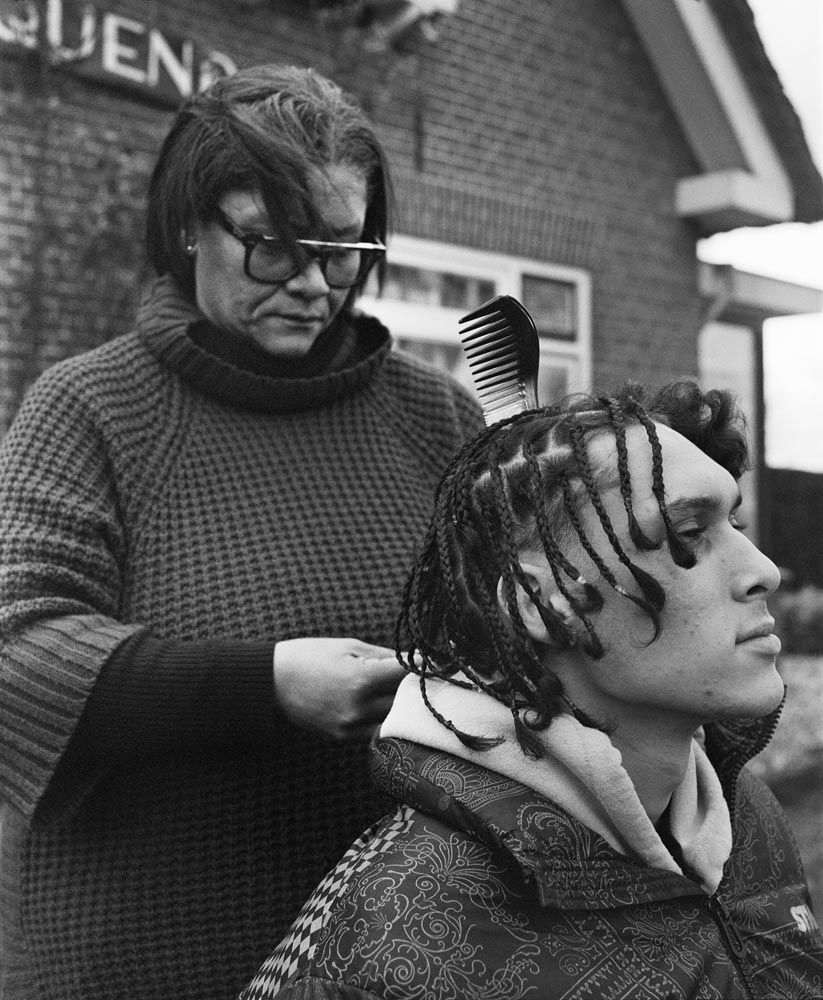

Left: Mom Braiding Alexander's Hair. 2023; Right: The Whole Picture. 2021
What is the best advice you would give to other artists?
Respect yourself and take your work seriously. Once you set that tone, you will radiate that energy. Everyone in your presence, within the art world or outside of it, will respect you too and see your work as something that matters.
It's not always easy knowing who you are and what you are trying to express through your work. Making art is the process of understanding the world around us and how we fit into it. I see it more as a process and journey than having directions to a clear destination. Most of the time, I do not even know where I am headed, but I trust the process. By taking all of this seriously, going the mile, trying new things, seeing your growth, learning new things, and seeing that you are capable of so much more than you thought, is beautiful. Do it all and so much more.
It will help you understand how you and your work need to be treated. You will start to understand and expand your boundaries, but also know that the struggle, sacrifice and love that went into creating needs to be catalysed into caring for the work once it starts finding its way into creative spaces such as galleries, museums, biennales and everywhere else. All of this lies with you.

Boycott Outspan Blood Oranges. 2024
Stay up to date with Farren van Wyk
Website farrenvanwyk.xyz
Instagram @farrenvwyk