Artist based in Miami, FL

Leticia Sanchez Toledo, portrait of the artist
Tell us about yourself, what's your background?
I was born and raised in Cuba, which is not something that can be overlooked. My mother and my older brother are also artists, another circumstance that has deeply shaped who I am. From a very young age, I felt drawn to images—those I found in painting, photography, and cinema. It was through painting that I discovered a space of curiosity and enjoyment, and over time I realized it was my language.
During those formative years, my mother did not particularly encourage my interest in painting. However, as the years passed, my persistence and dedication eventually convinced her that my commitment was genuine.
Being the youngest in a family of artists and wanting to follow in the footsteps of those who came before me gave me a resilience and determination that have stayed with me ever since.

Untitled, from the series Docile Metals and Memory, 2026. Oil on silver tray, 16 x 12 in.
I later studied Graphic Design at the Higher Institute of Design (ISDI) in Havana. I wanted to study something new. I already knew I would devote myself to painting, but I couldn't imagine sitting in a classroom learning something that already felt so familiar to me.
Before settling in Miami, I lived in several different countries. Those experiences have transformed my concerns and added new layers of meaning to my work. They are deeply informed by migration, memory, and the feeling of belonging—or not belonging—to different places at the same time.
I don't think there was a single moment when I decided to become an artist. It was a gradual and natural process. I simply couldn't imagine myself doing anything other than painting, because it was always what I loved most.

Son, 2025. Oil on paper, 18 x 24 in.
“I am interested in creating suspended atmospheres and moments of quiet stillness. . . the possibility of preserving a trace of their presence when we share a moment that feels meaningful to me, and ultimately transforming everyday life into a form of visual and emotional memory. Painting has that remarkable quality; it is an extraordinary exercise in memory.”

Flamingo Light, 2026. Oil on canvas, 26 x 40 in.
What are you currently working on and where did the inspiration for it come from?
At the moment, I am working on a project tentatively titled "In the Quiet Corner". It grew out of a desire to prolong what I consider a magical instant and transform it into a contemplative, lasting space through painting. It is, in many ways, a return to emotions we often leave unspoken—a way of slowing down and recovering those fragile moments that the relentless pace of contemporary life tends to sweep away.
I am interested in creating suspended atmospheres and moments of quiet stillness. What motivates me most is the empathy I feel toward the people I paint, the possibility of preserving a trace of their presence when we share a moment that feels meaningful to me, and ultimately transforming everyday life into a form of visual and emotional memory. Painting has that remarkable quality; it is an extraordinary exercise in memory.
I paint people from my immediate circle—friends, relatives, and acquaintances. Like me, many of them are immigrants trying to rebuild their lives in a new place. Through these intimate scenes, I reflect on the intersection of displacement and belonging, as well as on the quiet acts of resilience, beauty, and care that emerge in everyday life.

Untitled, from the series Docile Metals and Memory, 2026. Oil on tray, 10 x 15 in
The people I paint are not posing. We simply spend time together, and suddenly I notice them suspended in an image of quiet beauty. I am drawn to those moments of relaxation, when people are no longer guarded and reveal aspects of themselves that others might interpret as vulnerability. In many of these paintings, the figures merge with the interiors that surround them. The spaces speak as much as the people themselves; the light, the atmosphere, and the stillness of the objects all contribute to the emotional tone of the image.
My interest in these scenes began while visiting my mother in her studio. I took many photographs of her while she worked, completely immersed in the pleasure of painting. There was something deeply honest about those moments, and later I wanted to explore that same honesty in my own work.

Studio, work in progress, Photo by: Nicole Combeau
Today, this project is opening new opportunities. I am preparing an exhibition for Gallery Jenseits in Mt. Adams, Cincinnati, where I will continue developing these pictorial investigations. At the same time, I am working on the cover art for a jazz album, a project I am especially excited about because it allows me to bring my visual language into dialogue with music.
This work stems from a decade working in a quasi-documentary tradition, interested both in the photograph as visual record and the photograph as construct, aesthetic object, surface, and pigment. The exploratory fieldwork is an observational and intuitive process, whereas the studio intervention is analytically interpretive.
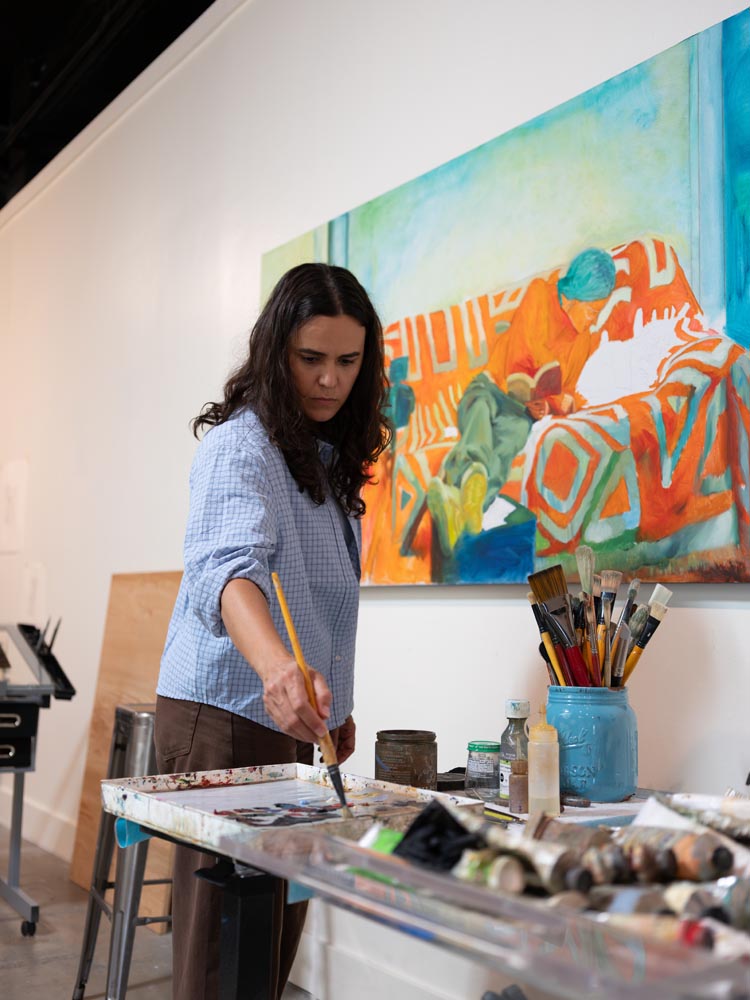

Left: In the studio, Photo by Nicole Combeau Right: Mother, 2025. Oil on canvas, 52 x 36 in.
Innovation does not only happen in the field of technology, where do you find inspiration?
I find inspiration in stepping outside my usual environment. Traveling and discovering new places and cultures forces me to question what I normally take for granted. Whenever I am somewhere unfamiliar, I pay closer attention to details. I observe the light, the architecture, the way people inhabit spaces and relate to one another. After returning from a trip, I often see my own surroundings differently and discover beauty or possibilities in everyday scenes that had previously gone unnoticed.
Visiting museums is another constant source of inspiration. I enjoy observing how other artists have solved problems of composition, color, narrative, or atmosphere. I always leave exhibitions with new questions, new ideas, and, above all, a renewed desire to return to the studio and paint.

Untitled, from the series Docile Metals and Memory, 2026. Oil on silver tray, 7 x 13 in.
Exchanging ideas with other artists also plays an important role in my practice. I am currently participating in the summer program at Bakehouse Art Complex, where I share a studio environment with artists working across disciplines such as sculpture, installation, textiles, and video. That exchange broadens the way I think about painting and constantly reminds me that there are always new ways of approaching the same problem. I will also soon take part in a residency in New York, an experience I hope will continue to nourish that dialogue with other artists and with new contexts.

The photographer, the painter and the writer, 2025. Oil on paper, 18 x 24 in
Where do ideas start for you?
I pay close attention to the images I encounter in everyday life. Sometimes a scene from a film, a particular quality of light, or an interesting composition sparks the possibility of creating something entirely different. I also find many ideas simply by observing people. Whenever I visit friends or family, I usually bring my camera with me. I enjoy spending time with them, waiting without interfering too much, and photographing those quiet moments, pauses, or small situations that would normally go unnoticed. That photographic archive has become a kind of visual diary that I return to constantly.
Once I'm back in the studio, another stage of the process begins. I revisit that archive, combine different references, make sketches, and allow the painting to transform the original point of departure. Very often, the finished work moves far away from the original photograph. I am not interested in documenting a scene, but in creating an atmosphere and an emotional experience that invites the viewer to complete the story through their own memories.

In the studio, Photo by Nicole Combeau
How do you make your work, does it start with a sketch?
My work almost always begins with drawing. Sometimes I make pencil sketches, but more often I create small studies in pastel or oil on paper. This stage is essential because it allows me to explore the atmosphere and, above all, to find the color palette I want to develop. For me, color is one of the most complex and essential aspects of a painting. It carries much of the emotional weight of the image.
Once I feel that exploration has reached a certain point, I move to the canvas. Although I already have a general direction, everything changes: the scale, the brushes, the physicality of the paint itself. I try to continue painting in a free and gestural way, allowing the work to develop without relying too heavily on the initial drawing. I want the image to retain its spontaneity and for the brushstrokes to preserve their vitality.
I don't think my style emerged from a conscious decision. It has been the result of years of work—of observing carefully, painting over and over again, and gradually discovering what I wanted to express through painting. Little by little, I realized that I was less interested in major events than in those seemingly ordinary moments. That interest, together with my approach to color, light, and atmosphere, has naturally shaped my visual language.
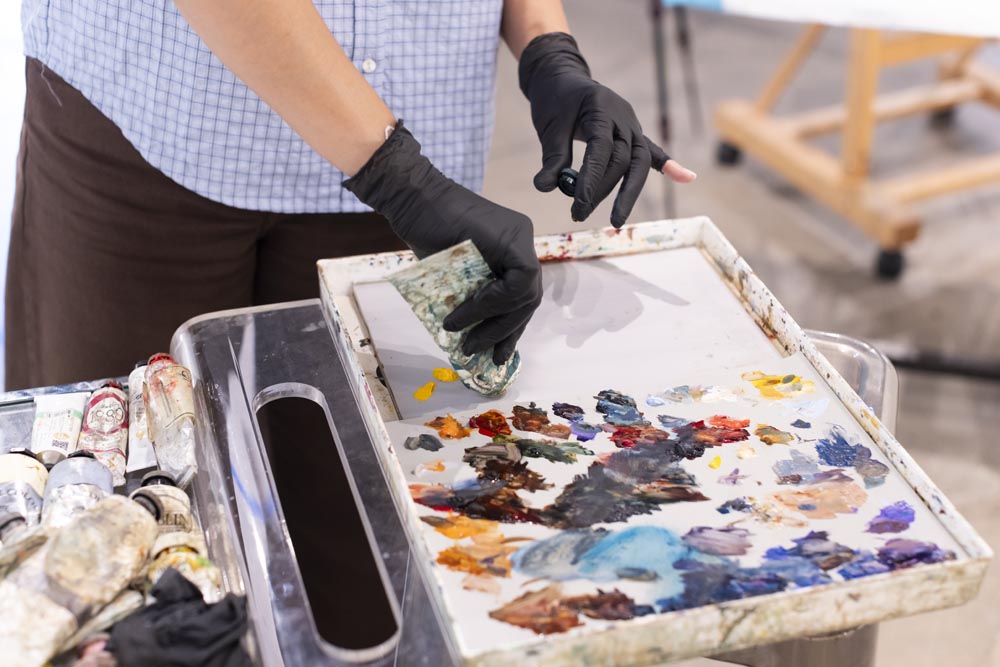

Left: Untitled, from the series Docile Metals and Memory, 2026. Oil on silver tray, 16 x 11 in. Right: Artist in the studio, Photo by Nicole Combeau
Many artists live by their routines and rituals, what does yours look like?
I've realized that I do need a certain routine. The most important thing for me is knowing that I have at least six uninterrupted hours to paint. If I know I'll be constantly interrupted or only have a couple of hours, it's very difficult for me to reach the level of concentration my work requires.
When I arrive at the studio, I never begin painting immediately. First I tidy up the space, browse through a few books, look carefully at the work I'm developing, and let the painting speak to me before I intervene. Then I prepare my palette and organize my materials. That entire ritual is part of the work, even if, from the outside, it looks as though I haven't started yet.
It usually takes me two or three hours to reach the level of concentration where I truly feel the painting begins to move forward. I almost always work while listening to music. Lately I've been listening to a lot of Vangelis, but I also have a somewhat unusual habit: I play films that I know by heart and simply listen to them while I paint. Since I already know exactly what's happening, I don't need to pay much attention to them, and they become a kind of soundscape that helps me stay focused. Strangely enough, I concentrate better that way than in complete silence. I can spend hours without noticing the time passing, forgetting to drink water or even to eat. It's an intense state that I try to protect because I feel that's where the best decisions happen.
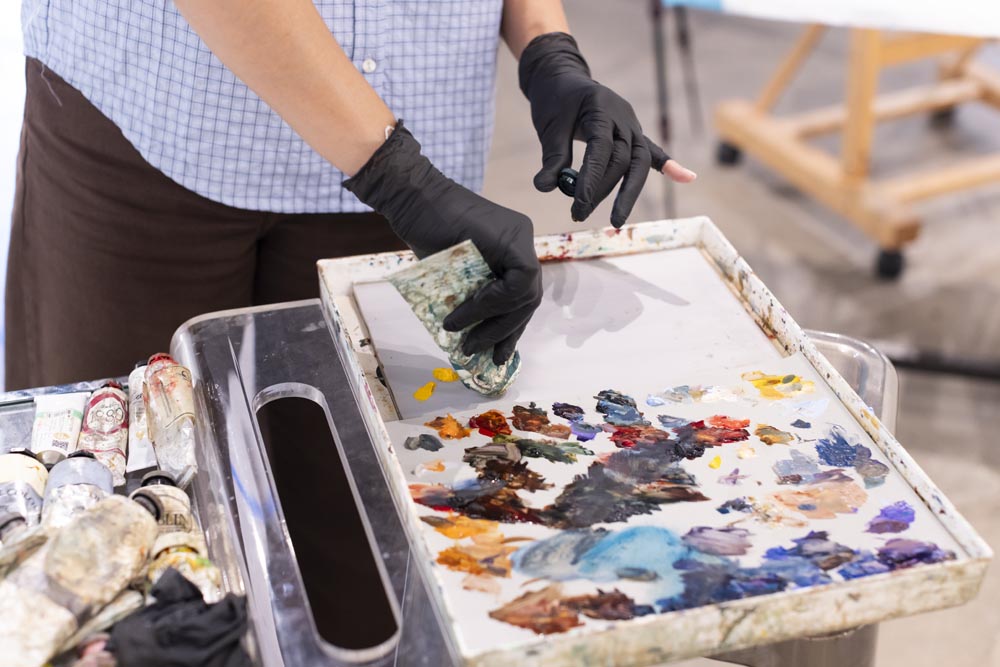

Studio view, Photo by Evelyn Sosa
Who are your biggest influences?
My earliest influences came very early in life, almost as a form of entertainment. My mother owned many art books, and I remember spending hours looking through one in particular about the Hermitage Museum. At that time, I had no access to computers or cell phones, television was very limited, and much of my free time was spent with those books and the films shown at the movie theater in my hometown. I believe that combination profoundly shaped the way I learned to see.
I remember being fascinated by the paintings of Bosch, Caravaggio, and Rubens. I didn't fully understand what I was looking at, but there was something in those images that kept drawing me back. Later, I discovered other artists who became very important to me, such as Tiepolo, Berthe Morisot, Édouard Vuillard, and George Bellows. Each of them taught me something different: how to construct space, use color and light, represent interiors, or tell a story without explaining too much.
Over the years, my influences have expanded considerably. Cinema, photography, and literature are as important to the way I think about painting as art history itself. I also admire contemporary painters such as Eric Fischl, Lisa Yuskavage, and Caroline Walker because each of them, in very different ways, has found a deeply personal approach to depicting intimacy, the body, and everyday life.

Studio view, Photo by Evelyn Sosa
Are there books or films that are an important source of inspiration?
I often return to the films of Wim Wenders, Wong Kar-wai, and Alfred Hitchcock. Beyond their stories, I am fascinated by their precise use of light, shadow, color, and composition.
In literature, I have found a particular affinity with the work of Raymond Carver. His stories reveal remarkable depth through seemingly ordinary situations. They are about ordinary people, silences, small gestures, and emotions that are only subtly suggested. I believe that way of observing life is also very present in my paintings. I am interested in creating scenes that appear simple at first glance but contain additional layers of meaning.

Untitled, from the series Docile Metals and Memory, 2026. Oil on silver tray, 15 x 11 in
What’s the best piece of advice you’ve been given?
The best advice I've ever received is that there is no such thing as a small project. Over time, I've realized that many of the most important opportunities in my career began with projects that initially seemed modest. That's why I try to approach every opportunity with the same level of commitment.

Dreaming of Kyoto, 2025. Oil on panel, 9 x 12 in.
What is the best advice you would give to other artists?
I would encourage them to observe carefully and not try to control everything. While I'm painting, unexpected solutions often emerge, and they usually end up being more interesting than my original idea. The important thing is learning to recognize those moments and give them space instead of dismissing them.
I would also encourage artists to step outside the studio whenever they can. Spending time with other artists, visiting exhibitions, going to museums, and traveling all help renew the way we see the world. I believe an artist never stops learning, and many of the best ideas emerge precisely when we change our perspective.

Leticia Sanchez Toledo, Photo by Evelyn Sosa
Stay up to date with Leticia Sanchez Toledo
Website leticiasanchez.com